
Safety - at the heart of all thinking.
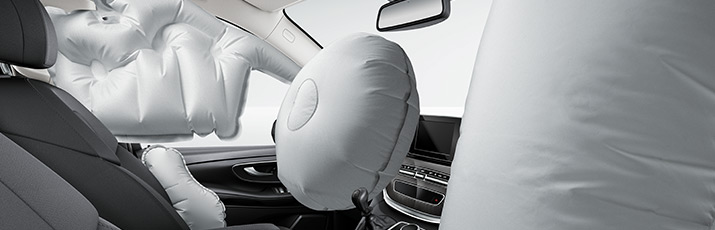
Comprehensive protection in four phases.
The V-Class sets benchmarks where safety is concerned. Its comprehensive range of safety equipment and systems is aligned to the integral safety concept from Mercedes-Benz, which is made up of four phases: starting with safe driving, then moving on to preventive protection in the event of danger, and then onto appropriate protection in an accident, and finally on to damage limitation following an accident.
Phase 1: safe driving
Most accidents start long before the actual collision: with a lapse in concentration, poor visibility or hazards which cannot be anticipated. That's why the Mercedes-Benz safety concept employs a range of measures to support stress-free driving in everyday operation and to help you bring critical situations under control.
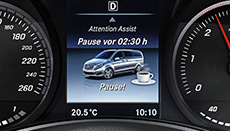
ATTENTION ASSIST
The standard-specification ATTENTION ASSIST system can - in particular on long or night journeys - increase driving safety and can help to avoid momentary nodding off. The system gives the driver visual and acoustic warnings if it detects typical signs of overtiredness or inattention, and urges the driver to take a break. Steering movements are analysed to evaluate driving style and an individual driver profile created.
A five-stage, colour bar chart visualises the degree of attention being shown by the driver and displays this in the multifunction display of the instrument cluster. If ATTENTION ASSIST ascertains that the level of attention is low, it displays the symbol of a cup of coffee to encourage the driver to take a break, and an acoustic signal is sounded. The system works at speeds between 60 and 200 km/h, can be set to display at a determined (in)attention level and can be switched off entirely.
Crosswind Assist
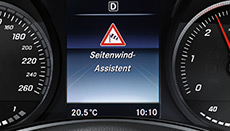
The standard-specification Crosswind Assist assists the driver when there are unexpected, string gusts of wind, thereby increasing driving safety. It provides additional driving safety and takes the strain off the driver, in particular on bridges or when passing trucks and coaches and in strong gusts of wind.
If the ESP® sensors detect gusts of crosswind, the system brakes the wheels facing the wind. This reduces axle offset considerably. A control lamp in the instrument cluster informs the driver if Crosswind Assist is intervening.
Phase 2: in critical situations
Mercedes-Benz stands for automotive safety. That's why our vehicles can support their passengers even in critical driving situations, so that every journey is as safe as it can possibly be.
PRE-SAFE® (optional)
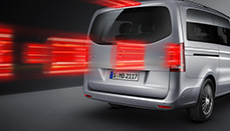
The PRE-SAFE® preventive occupant protection system can identify potentially critical driving situations at an early stage and initiate protective measures for the occupants. The measures include reversible tightening of the driver's and front passenger's seat belts, closing open windows and roof systems and – in conjunction with electric seat adjustment – positioning the front passenger seat in a better position to cope with an accident.
The intelligent accident early-warning system in the PRE-SAFE® system works through the sensors present in the vehicle, e.g. the Electronic Stability Program ESP® or BAS PRO Brake Assist. The protective mechanisms of the PRE-SAFE® system are triggered by panic braking, in which the driver needs to brake harder than road conditions would normally allow, and by acute steering movements at high speeds.
The PRE-SAFE® system is optionally available for the V-Class and standard for the V-Class AVANTGARDE.In conjunction with the optional electric seat adjustment function, the scope of the system widens to include the positioning of the front passenger seat in a better position to cope with an accident.
Phase 3: in an accident
Cars from Mercedes-Benz have a host of safety systems to prevent accidents. Should the worst come to the worst, however, a number of occupant safety measures are activated. They include protection for the vehicle occupants as well as for other road users:
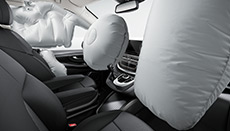
Airbags, thorax-pelvis sidebags and windowbags for driver and front passenger
The extensive deployment of airbags and other restraint systems means that exemplary protection can be offered in the V-Class in an accident. Driver and front passenger airbags as well as windowbags and thorax-pelvis sidebags for driver and front passenger are all part of the standard specification. The optional windowbags in the rear extend the airbag protection to the passenger compartment.
The windowbags for driver and front passenger can considerably reduce the risk of head injuries if there is side-on impact against the windows or from objects penetrating into the interior. They are triggered if the sensors recognise a strong side impact is occurring. The windowbag on the side receiving the impact inflates in the area of the side window.
Phase 4: after an accident
The immediate introduction of suitable rescue measures after an accident is key. In the V-Class various mechanisms, which are dependent on the type and severity of the accident, can alleviate the consequences of an accident and facilitate a rapid rescue.
The engine, for example, switches off automatically; and the door locking mechanism unlocks itself.
V-Class
V-Class
Facts and figures
| Note: Some models / features may not be available for the Indonesia market. |
